 World Dawah Quran & Sunnah through understanding of Salaf
بسم الله الرحمن الرحيم
An introduction explaining the reality of Tawḥīd according to Muslims, what they mean when they say that Allah is One without partner, and what this necessarily entails regarding singling Him out in His Lordship, His right to worship, and His Names and Attributes.
This is because judging a matter properly depends upon first understanding it correctly. Much of the confusion surrounding discussions of Tawḥīd and shirk arises from a lack of clarity concerning the meanings of God, Lord, and worship. Some people may assume that Tawḥīd amounts merely to believing that Allah is the Creator of the universe, whereas this alone is not the Tawḥīd to which the messengers called, even though it is a fundamental part of it.
Rather, the Tawḥīd brought by the messengers includes believing that Allah alone is the Lord, Creator, Owner, and Sustainer of all things; that He alone, Glorified and Exalted, deserves every form of worship; and that He possesses the attributes of perfection, is exalted above every deficiency and imperfection, and that nothing from His creation is comparable to Him.
Whoever properly understands this foundation will then find it easier to understand the true nature of the disagreement concerning the divinity of Christ. The discussion is not merely about honoring Christ, peace be upon him, nor about affirming his prophethood, virtue, and miracles. Rather, the discussion concerns directing to someone other than Allah—whoever that may be—what belongs exclusively to Allah and is His right alone.
For this reason, this foundation must first be clearly established before proceeding to what follows.
First: The Definition of Tawḥīd and Its Importance
Tawḥīd is to single out Allah, the Exalted, in His Lordship and His exclusive right to worship, and to affirm the perfection of His Names and Attributes in a manner befitting Him, Glorified and Exalted.
Tawḥīd is therefore not merely the acknowledgment that Allah exists, nor merely the acknowledgment that He created the heavens and the earth. Rather, its reality is to single Allah out in that which belongs exclusively to Him: to believe that He is the Lord who has no partner in His Lordship, the God besides whom none deserves worship, and that to Him belong the Most Beautiful Names and the Most Exalted Attributes, in which nothing from His creation resembles Him.
Tawḥīd is Allah’s right upon His servants. It is the greatest command of the religion and the foundation of all its foundations. Upon it depends the validity and acceptance of all deeds.
The Prophet ﷺ explained this explicitly in the hadith of Muʿādh ibn Jabal, may Allah be pleased with him, who said:
“I was riding behind the Prophet ﷺ on a donkey when he said to me: ‘O Muʿādh, do you know what Allah’s right upon His servants is, and what the servants’ right upon Allah is?’
I said: ‘Allah and His Messenger know best.’
He said: ‘Allah’s right upon His servants is that they worship Him and associate nothing with Him, and the servants’ right upon Allah is that He does not punish anyone who associates nothing with Him.’
I said: ‘O Messenger of Allah, should I not give the people this glad tidings?’
He said: ‘Do not give them the glad tidings, lest they rely upon it.’”
Source: Narrated by al-Bukhārī (2856) and Muslim (30), with slight differences in wording. Agreed upon, from the hadith of Muʿādh ibn Jabal, may Allah be pleased with him.
Consider how the Prophet ﷺ declared Allah’s right upon His servants to be that they worship Him and associate nothing with Him. In these few words, he gathered together the foundation of the entire religion: worshipping Allah, singling Him out in worship, and disassociating oneself from shirk.
His statement, “and associate nothing with Him,” uses an indefinite expression in the context of a prohibition, and therefore encompasses everything. Nothing whatsoever may be made a partner with Allah in worship—not an angel brought near to Him, nor a messenger sent by Him, nor a righteous person, nor anyone else.
From this, it becomes clear that Tawḥīd is not a secondary matter among matters of belief. Rather, it is the foundation to which all the other foundations of religion return, and it is for its sake that the messengers were sent and the Books were revealed.
Allah, Glorified and Exalted, repeatedly affirms His Oneness throughout the Qurʾān, to such an extent that the entire Qurʾān revolves around establishing Tawḥīd and its rights, explaining its reward, and warning against shirk and its people.
Among the most comprehensive sūrahs concerning this is Sūrat al-Ikhlāṣ. Allah, the Exalted, says:
“Say: He is Allah, One.
Allah, the Self-Sufficient.
He neither begets nor is born.
And there is none comparable to Him.”
Source: Sūrat al-Ikhlāṣ, 112:1–4.
Despite its few words, this sūrah encompasses fundamental truths concerning the knowledge of Allah that refute major foundations of shirk and misguidance.
Allah affirms His absolute Oneness: He has no partner, equal, or likeness.
He affirms His Self-Sufficiency: He is perfect in His attributes, the One to whom all turn for their needs; His creation is utterly dependent upon Him, while He is completely independent of them.
He denies that He is either a father or one who was born, saying:
“He neither begets nor is born.”
He then concludes by denying that anything is equal or comparable to Him:
“And there is none comparable to Him.”
Thus, this sūrah combines the affirmation of the perfection of His Oneness, the affirmation of His perfect Self-Sufficiency, the denial that He begets or is begotten, and the denial of any equal or likeness to Him.
Allah, the Exalted, also says:
“And Allah has said: ‘Do not take two gods. He is only One God, so fear Me alone.’”
Source: Sūrat al-Naḥl, 16:51.
His statement:
“He is only One God”
restricts rightful divinity to one God alone. He then follows this by commanding that fear and worship be directed exclusively to Him:
“So fear Me alone.”
Allah, Glorified and Exalted, also says:
“Say, ‘What thing is greatest in testimony?’ Say, ‘Allah is Witness between me and you. And this Qurʾān has been revealed to me so that I may warn you with it and whoever it reaches. Do you truly testify that there are other gods alongside Allah?’ Say, ‘I do not testify to this.’ Say, ‘He is only One God, and indeed, I am free of whatever you associate with Him.’”
Source: Sūrat al-Anʿām, 6:19.
Here, Allah combines the affirmation that He is One God with disassociation from everything associated with Him. These are the two pillars of Tawḥīd: affirming worship for Allah alone and denying it to everything besides Him.
The Qurʾān does not merely declare the Oneness of Allah. Rather, it also establishes rational proofs for it and demonstrates the falsehood of belief in multiple gods.
Allah, Glorified and Exalted, says:
“Had there been within them gods besides Allah, both would surely have fallen into disorder. Glorified is Allah, Lord of the Throne, above what they attribute to Him.”
Source: Sūrat al-Anbiyāʾ, 21:22.
And Allah, the Exalted, says:
“Say, ‘If there had been other gods alongside Him, as they claim, they would surely have sought a way to the Lord of the Throne.’”
Source: Sūrat al-Isrāʾ, 17:42.
And Allah, Glorified and Exalted, says:
“Allah has never taken a son, nor has there ever been any god alongside Him. Had there been, each god would have taken away what he created, and some would have sought supremacy over others. Glorified is Allah above what they attribute to Him.”
Source: Sūrat al-Muʾminūn, 23:91.
This last verse combines the denial of a son with the denial of any partner in divinity, and then establishes an argument demonstrating the impossibility of multiple gods. For if there were true gods alongside Allah, each possessing the characteristics of divinity, power, and will possessed by the others, this would entail each god independently taking control of what he created, some seeking supremacy over others, and the orderly governance of the universe being corrupted.
The harmonious order of creation under a single governance, the interconnectedness of its various parts, and the execution of a single will throughout it are among the evidences that its Lord is One, Glorified and Exalted.
These verses are but a small portion of a vast subject, for the evidences of Allah’s Tawḥīd throughout the Qurʾān are far too numerous to be encompassed within this introduction.
Second: The Categories of Tawḥīd
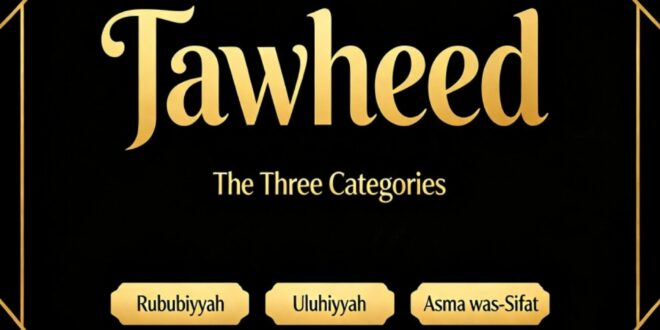
A comprehensive examination of the texts of the Qurʾān and Sunnah shows that the Tawḥīd that is due to Allah, Glorified and Exalted, falls into three categories:
The first: Tawḥīd of Lordship (Tawḥīd al-Rubūbiyyah).
The second: Tawḥīd of Worship (Tawḥīd al-Ulūhiyyah), also called Tawḥīd al-ʿIbādah.
The third: Tawḥīd of the Names and Attributes (Tawḥīd al-Asmāʾ wa-l-Ṣifāt).
These categories are not separate from one another in such a way that one can be perfectly affirmed while the others are rejected. Rather, they are inseparably connected, each necessarily implying the others. Allah’s uniqueness in creation, ownership, and governance necessarily entails that He alone deserves worship, while the perfection of His Names and Attributes is among the greatest demonstrations of His exclusive right to Lordship and worship.
Each of these categories will now be explained.
The First Category: Tawḥīd of Lordship
Tawḥīd of Lordship means singling out Allah, Glorified and Exalted, in His actions and firmly believing that He alone is the Lord, unique in creation, ownership, provision, governance, giving life, and causing death, and that He has no partner in any of these.
Allah, Glorified and Exalted, is the Lord of the worlds, the Lord and Sovereign of all things. He created creation from nothing, provided for them, governed their affairs, gave life and caused death. He nurtures all of His creation through His blessings, and He nurtures the chosen among His creation—the prophets and their followers—through sound beliefs, noble character, beneficial knowledge, and righteous deeds.
There is therefore no true Creator except Allah.
Allah, the Exalted, says:
“Allah is the Creator of all things, and He is the Disposer of affairs over all things.”
Source: Sūrat al-Zumar, 39:62.
Nor is there any true provider for creation except Him. Allah, the Exalted, says:
“There is no creature on earth except that its provision is upon Allah. He knows its dwelling place and its place of storage. All is recorded in a clear Book.”
Source: Sūrat Hūd, 11:6.
And He, Glorified and Exalted, says:
“Indeed, Allah alone is the Provider, the Possessor of Power, the Most Strong.”
Source: Sūrat al-Dhāriyāt, 51:58.
He, Glorified and Exalted, is the One who governs the affairs of His creation. Allah, the Exalted, says:
“He governs the affair from the heaven to the earth; then it ascends to Him in a Day whose measure is a thousand years according to your reckoning.”
Source: Sūrat al-Sajdah, 32:5.
And He is the One who gives life and causes death. He, Glorified and Exalted, says:
“He gives life and causes death, and to Him you will be returned.”
Source: Sūrat Yūnus, 10:56.
The texts of revelation repeatedly affirm His Lordship.
Allah, the Exalted, says:
“All praise is due to Allah, Lord of the worlds.”
Source: Sūrat al-Fātiḥah, 1:2.
And He, Glorified and Exalted, says:
“Unquestionably, creation and command belong to Him. Blessed is Allah, Lord of the worlds.”
Source: Sūrat al-Aʿrāf, 7:54.
And He says:
“He is the One who created for you all that is on the earth.”
Source: Sūrat al-Baqarah, 2:29.
Tawḥīd of Lordship therefore includes affirming that all creation belongs to Allah, all sovereignty belongs to Allah, and all command belongs to Allah; that every created being is utterly dependent upon Him, while He, Glorified and Exalted, is completely independent of them.
However, an important principle must be emphasized here: merely affirming Tawḥīd of Lordship is not, by itself, sufficient for a person to be a true monotheist in the sense taught by the messengers.
The polytheists among whom the Messenger of Allah ﷺ was sent affirmed a great deal of Allah’s Lordship. They acknowledged that He was the Creator of the heavens and the earth, that He subjected the sun and the moon, and that He governs all affairs. Yet this acknowledgment did not make them Muslims, because they associated others with Him in worship.
Allah, the Exalted, says:
“If you ask them, ‘Who created the heavens and the earth and subjected the sun and the moon?’ they will certainly say, ‘Allah.’ How, then, are they turned away?”
Source: Sūrat al-ʿAnkabūt, 29:61.
And He, Glorified and Exalted, argues against them on the basis of what they themselves acknowledge:
“Say, ‘To whom belong the earth and all those within it, if you know?’
They will say, ‘To Allah.’ Say, ‘Will you not then take heed?’
Say, ‘Who is the Lord of the seven heavens and the Lord of the Mighty Throne?’
They will say, ‘Allah.’ Say, ‘Will you not then fear Him?’
Say, ‘In whose hand is the dominion of all things, who protects while none can protect against Him, if you know?’
They will say, ‘Allah.’ Say, ‘How, then, are you deluded?’
Rather, We have brought them the truth, and indeed they are liars.”
Source: Sūrat al-Muʾminūn, 23:84–90.
Consider how they acknowledged that the earth and all those within it belong to Allah, that He is the Lord of the seven heavens and the Lord of the Mighty Throne, and that the dominion of all things is in His hand. Yet Allah did not consider them, on account of this alone, to be people of Tawḥīd.
Why?
Because acknowledging that Allah is the Lord of the worlds necessarily entails that He alone is the God of the worlds.
If He is the One who created you, provided for you, gave you life, and will cause you to die; if the dominion of all things is in His hand; and if no created being can remain independent of Him for even the blink of an eye—then how can any act of worship be directed to someone other than Him?
For this reason, the Qurʾān frequently argues against the polytheists on the basis of the Tawḥīd of Lordship that they already acknowledged, thereby establishing against them the necessity of Tawḥīd of Worship.
Here, the inseparable connection between these two categories becomes clear:
The One who alone creates, owns, and governs is the One who alone deserves to be worshipped.
From here, we move to the category that constituted the greatest objective of the call of the messengers.
The Second Category: Tawḥīd of Worship
This is also called Tawḥīd al-ʿIbādah.
It means singling out Allah, Glorified and Exalted, in the acts of His servants through which He has commanded them to worship Him, and firmly believing that Allah is the true God, that none besides Him deserves worship, and that everything worshipped besides Him is false.
Just as there is no Lord of the worlds except Allah, there is no God who deserves worship except Allah.
The reality of this Tawḥīd is that the servant singles out his Lord in worship and submission. He does not make any partner with Him in worship, whoever that may be, nor does he direct any form of worship to anyone besides Him—such as prayer, fasting, zakāh, Ḥajj, supplication, vows, sacrifice, reliance, seeking refuge, seeking aid in matters that none can accomplish except Allah, worshipful fear, hope, devotional love, and other acts of the heart and limbs.
The servant worships his Lord through love, fear, and hope together: he loves Him, Glorified and Exalted, with the greatest love, hopes in Him, fears Him, humbles himself before Him, and submits to Him.
Allah, the Exalted, says:
“You alone we worship, and You alone we ask for help.”
Source: Sūrat al-Fātiḥah, 1:5.
Placing the object first in His statement:
“You alone we worship”
indicates exclusivity; that is: we worship You and we worship no one besides You.
The matter is therefore not that Allah should be one among several beings who are worshipped, nor that He should receive the greatest share of worship while some portion of it is given to others. Rather, Tawḥīd means that all worship belongs to Allah.
For this reason, Allah, the Exalted, says:
“Worship Allah and associate nothing with Him.”
Source: Sūrat al-Nisāʾ, 4:36.
And He, Glorified and Exalted, says:
“Whoever invokes another god alongside Allah, for which he has no proof, his reckoning is only with his Lord. Indeed, the disbelievers will not succeed.”
Source: Sūrat al-Muʾminūn, 23:117.
This Tawḥīd is what all the messengers, from the first of them to the last, called their people to.
Allah, the Exalted, says:
“We never sent a messenger before you except that We revealed to him: ‘There is no god worthy of worship except Me, so worship Me.’”
Source: Sūrat al-Anbiyāʾ, 21:25.
And He, Glorified and Exalted, says:
“We certainly sent into every nation a messenger, saying: ‘Worship Allah and avoid ṭāghūt.’”
Source: Sūrat al-Naḥl, 16:36.
Allah, Glorified and Exalted, informs us that He sent a messenger to every nation with this call, and then summarizes its meaning in two foundations:
“Worship Allah”
This affirms worship for Allah.
And:
“Avoid ṭāghūt”
This negates the worship of everything besides Him.
This is the reality of the declaration of Tawḥīd:
Lā ilāha illa Allāh—there is no god worthy of worship except Allah.
The words “there is no god” negate the right to worship from everything besides Allah, while “except Allah” affirm that right for Allah alone.
For this reason, the declaration of Tawḥīd was not merely the statement, “There is no Creator except Allah.” The polytheists already acknowledged that Allah was their Creator and the Creator of the heavens and the earth. What their hearts rejected was that worship should be devoted exclusively to Allah alone.
Allah, the Exalted, relates their words:
“Has he made all the gods into One God? Indeed, this is a remarkable thing!”
Source: Sūrat Ṣād, 38:5.
Had the Prophet ﷺ merely intended for them to acknowledge that the Creator of the universe is one, this objection would have made no sense, since they already acknowledged that.
Rather, they understood from his call to “Lā ilāha illa Allāh” that he was demanding that they abolish the worship of everything they worshipped besides Allah and devote all worship exclusively to Allah alone. For this reason, they said:
“Has he made all the gods into One God?”
From here, the distinction between Lord (Rabb) and God (Ilaah) in this context becomes clear. The Lord is the Creator, Owner, and Governor, whereas the God is the One who is worshipped, whom hearts worship with love, veneration, humility, and submission.
Thus, a polytheist’s acknowledgment that Allah is the Lord of the worlds is an argument against him establishing the obligation to single Allah out in worship; it is not an excuse for associating others with Him.
The One who is the Lord, Creator, Provider, Owner, and Governor; who gives life and causes death; who is described with the attributes of perfection and exalted above all deficiencies; and in whose hand is the dominion of all things—He is the One who must be worshipped alone, to the exclusion of everything else.
For this reason, Allah, the Exalted, says:
“I did not create jinn and mankind except to worship Me.”
Source: Sūrat al-Dhāriyāt, 51:56.
Allah created jinn and mankind to worship Him. He did not create them to assign partners to Him in worship.
The polytheists generally did not believe that their idols had created the heavens and the earth. Rather, they took those whom they worshipped besides Allah as intermediaries and intercessors, claiming that they would bring them nearer to Allah.
Allah, the Exalted, says:
“As for those who take protectors besides Him, saying, ‘We worship them only so that they may bring us nearer to Allah in position.’”
Source: Sūrat al-Zumar, 39:3.
Allah called what they did worship, even though they made it a means of drawing nearer to Him. Neither their acknowledgment of Allah nor their intention to draw nearer to Him made it permissible for them to direct worship to others besides Him.
This establishes an important principle that must be clearly understood:
Shirk does not depend upon a person believing that the one he worships besides Allah created the heavens and the earth. A person may acknowledge that Allah is the Creator and yet associate others with Him in worship.
For this reason, Tawḥīd of Worship rests upon two great foundations:
The First Foundation: Devoting Worship Exclusively to Allah
No act of worship may be directed to anyone besides Allah.
Prayer is offered only to Allah. The prostration of worship is made only to Him. Sacrificial slaughter as an act of devotion is offered only to Him. Vows made as acts of worship are made only to Him. Supplication as an act of worship, and requests concerning matters that none can accomplish except Allah, are directed only to Him. Worshipful reliance is placed only upon Him. Nor is refuge or aid sought, in matters that none can accomplish except Allah, from anyone besides Him.
This does not mean that seeking help from a created being is absolutely forbidden. Seeking the help of a living and present person in something within that person’s ability is not the worshipful seeking of help that belongs exclusively to Allah. What is forbidden is to attribute to a created being something that belongs exclusively to the Creator, or to direct to a created being that which none deserves except Allah.
Allah, the Exalted, says:
“Your Lord has said: ‘Call upon Me; I will answer you.’”
Source: Sūrat Ghāfir, 40:60.
And He, Glorified and Exalted, says:
“So do not fear them, but fear Me, if you are believers.”
Source: Sūrat Āl ʿImrān, 3:175.
And Allah, the Exalted, says:
“And upon Allah place your trust, if you are believers.”
Source: Sūrat al-Māʾidah, 5:23.
And He says:
“You alone we worship, and You alone we ask for help.”
Source: Sūrat al-Fātiḥah, 1:5.
And He, Glorified and Exalted, says:
“Say: I seek refuge in the Lord of mankind.”
Source: Sūrat al-Nās, 114:1.
The point is that Allah, Glorified and Exalted, must be the ultimate object of the servant’s intention and worship. The servant must not place between himself and Allah another object of worship to whom he directs any act of worship.
The Second Foundation: Worship Must Be in Accordance with What Allah Has Legislated
Tawḥīd does not mean that a person may worship Allah in whatever manner his own reason or desires deem good. Rather, along with devoting worship sincerely to Allah, that worship must conform to what He, Glorified and Exalted, has legislated through His Messenger ﷺ.
The first foundation is the fulfillment of the testimony:
Lā ilāha illa Allāh—there is no god worthy of worship except Allah.
The second foundation is the fulfillment of the testimony:
Muḥammad is the Messenger of Allah.
Through the testimony that there is no god worthy of worship except Allah, Allah alone is singled out as the One to be worshipped.
And through the testimony that Muḥammad is the Messenger of Allah, the Messenger ﷺ alone is followed in what he conveyed from his Lord.
In this way, sincerity and adherence to the Messenger come together, and these are the two foundations for the acceptance of worship.
The Inseparable Connection Between Tawḥīd of Lordship and Tawḥīd of Worship
Once what has preceded is understood, it becomes clear that Tawḥīd of Lordship and Tawḥīd of Worship are not two disconnected realities. Rather, each points to the other.
Tawḥīd of Lordship is evidence for Tawḥīd of Worship.
And Tawḥīd of Worship necessarily includes acknowledgment of the Lordship of the One who is worshipped, Glorified and Exalted.
For the one who truly worships Allah alone does so because he believes that Allah is his Lord, Creator, and Owner, and that He alone possesses perfect self-sufficiency, power, knowledge, wisdom, mercy, and all other attributes of perfection.
For this reason, the Qurʾān frequently uses the first as an argument for the second.
It is as though Allah, Glorified and Exalted, is saying to His servants: If you acknowledge that I created you and provided for you, that the heavens and the earth belong to Me, and that the dominion of all things is in My hand, then how can you worship anyone besides Me?
This is among the clearest of arguments and among those most readily recognized by both sound human nature and reason.
How can one who does not create be worshipped?
How can one who possesses neither harm nor benefit even for himself—let alone for others—be made an equal to the One in whose hand is the dominion of all things?
And how can one who is dependent upon Allah for his very existence, continued existence, and every aspect of his affairs be made equal to the Lord of the worlds in any of the rights of worship?
For this reason, the call of all the prophets was founded upon this principle.
Nūḥ, Hūd, Ṣāliḥ, Shuʿayb, and other messengers of Allah each said to their people:
“O my people, worship Allah. You have no god worthy of worship besides Him.”
This was the call of Muḥammad ﷺ, and it was the call of Abraham, Moses, Jesus, and all the other prophets, peace and blessings be upon them.
The purpose of the divine messages was not merely that a person should know that this universe has a Creator. Sound human nature and reason already point to this, and many of the polytheists themselves acknowledged it. Rather, the purpose is that a person should know his Lord and worship Him alone, making no equal with Him in his love, worship, supplication, fear, or hope.
From this, it becomes clear that the Tawḥīd brought by the messengers does not permit a person to say: We worship Allah, and we also worship another alongside Him—even if that other were an angel brought near to Allah or a messenger sent by Him.
The prophets themselves came to abolish this very principle. Allah never sent a prophet to command people to worship that prophet instead of Allah or alongside Allah. Rather, He sent them all to say to the people:
“Worship Allah. You have no god worthy of worship besides Him.”
The tremendous significance of this principle will become clear later when we discuss Christ, Jesus son of Mary, peace be upon him. Establishing his exalted status, his prophethood, his messengership, and his miracles is one matter; establishing that he deserves worship is another matter entirely. The former does not in any way necessitate the latter.
Rather, the more firmly his prophethood is established, the more firmly it is established that he was among those who called people to the Tawḥīd of Allah and to worship Him alone. This will be explained in its proper place in this book.
Having now explained the Tawḥīd of Allah in His Lordship and His exclusive right to worship, there remains the third category: Tawḥīd of the Names and Attributes. This is a tremendous subject concerning the knowledge of the Lord, Glorified and Exalted, and through it the explanation of the creed of Ahl al-Sunnah wa-l-Jamāʿah concerning the One whom they worship and single out in Tawḥīd is completed.
The Third Category: Tawḥīd of the Names and Attributes
The third category of Tawḥīd is Tawḥīd of the Names and Attributes (Tawḥīd al-Asmāʾ wa-l-Ṣifāt).
Its meaning is to firmly believe that Allah, Mighty and Majestic, possesses the Most Beautiful Names and the Most Exalted Attributes; that He, Glorified and Exalted, possesses every attribute of perfection and is exalted above every attribute of deficiency and imperfection; and that He is unique in the attributes of perfection that belong to Him, with none of His creation resembling Him in them.
The way of Ahl al-Sunnah wa-l-Jamāʿah in this matter is to describe Allah with what He has described Himself with in His Book and with what His Messenger ﷺ described Him with in the authentic Sunnah, for Allah knows Himself better than His creation does, and His Messenger ﷺ knew his Lord better than any other created being.
They therefore do not affirm any name or attribute for Allah merely on the basis of opinion or desire, nor do they deny what He has affirmed for Himself. Rather, they stop where the Qurʾān and Sunnah stop.
They affirm what Allah has affirmed for Himself and what His Messenger ﷺ affirmed for Him, in a manner befitting His majesty, without distortion (taḥrīf), denial (taʿṭīl), asking how (takyīf), or likening Him to His creation (tamthīl).
And they deny of Him whatever He has denied of Himself, or His Messenger ﷺ has denied of Him, including deficiencies, imperfections, and everything incompatible with His perfection.
They therefore follow a middle course between those who liken the attributes of the Creator to the attributes of created beings and those who deny the attributes of the Creator in an attempt to escape such resemblance.
The one who likens Allah to His creation worships an image he has imagined, while the one who denies His attributes worships a nonentity. As for Ahl al-Sunnah, they affirm for Allah the perfection He has affirmed for Himself while declaring Him exalted above any resemblance to His creation.
The comprehensive foundation governing this subject is the statement of Allah, the Exalted:
“There is nothing like unto Him, and He is the All-Hearing, the All-Seeing.”
Source: Sūrat al-Shūrā, 42:11.
This verse combines the foundation of declaring Allah incomparable with the foundation of affirming His Attributes.
His statement:
“There is nothing like unto Him”
is a refutation of those who liken or compare Allah to His creation.
And His statement:
“And He is the All-Hearing, the All-Seeing”
is a refutation of those who deny or negate His Attributes.
Allah, Glorified and Exalted, did not make the affirmation of hearing and sight entail resemblance to created beings, just as He did not make the denial of resemblance entail the denial of His Attributes.
This is a fundamental principle that must be clearly understood: sharing a name does not necessitate sharing the same reality or modality.
Allah, Glorified and Exalted, has described Himself with knowledge, and He has described some of His creation with knowledge, yet His knowledge is not like their knowledge. He has described Himself with hearing and sight, and He has described some of His creation with hearing and sight, yet His hearing is not like their hearing, nor is His sight like their sight. He has affirmed life for Himself and has described some of His creation as living, yet His life is not like their lives.
If sharing the basic meaning of a name does not necessitate identical realities even among created beings themselves, then it is even more evident that it does not necessitate such identity between the Creator and the created.
For this reason, the methodology of the Salaf rests upon two foundations, neither of which is sound without the other:
Affirmation without resemblance, and transcendence without denial.
When they affirm for Allah what He has affirmed for Himself, they do not liken His Attributes to the attributes of His creation. And when they declare Him exalted above resemblance to His creation, they do not deny the Attributes with which He has described Himself.
Allah, the Exalted, says:
“To Allah belong the Most Beautiful Names, so call upon Him by them, and leave those who deviate concerning His Names. They will be recompensed for what they used to do.”
Source: Sūrat al-Aʿrāf, 7:180.
Allah, Glorified and Exalted, thus affirms for Himself the Most Beautiful Names, commands His servants to call upon Him by them, and forbids deviation concerning them.
Among His Names, Glorified and Exalted, are al-Raḥmān (the Most Merciful), al-Raḥīm (the Especially Merciful), al-Samīʿ (the All-Hearing), al-Baṣīr (the All-Seeing), al-ʿAlīm (the All-Knowing), al-Ḥakīm (the All-Wise), al-ʿAzīz (the Almighty), al-Qadīr (the All-Powerful), al-Ḥayy (the Ever-Living), al-Qayyūm (the Self-Sustaining, Sustainer of all), and the other Most Beautiful Names by which He has named Himself or by which His Messenger ﷺ named Him.
Every one of His Names, Glorified and Exalted, is a name of perfection and praise. There is no name among His Names that implies deficiency in any respect whatsoever.
What Is Said Concerning Allah’s Attributes Follows What Is Said Concerning His Essence
Among the principles by which the falsehood of many doubts concerning this subject becomes clear is the following:
Allah, Glorified and Exalted, has a true Essence that does not resemble the essences of created beings. Likewise, He has true Attributes that do not resemble their attributes.
Whoever affirms for Allah an Essence unlike all other essences must not regard the affirmation of His Attributes as necessarily entailing resemblance to creation, for what is said concerning the Attributes follows what is said concerning the Essence.
Just as we know that Allah has an Essence without knowing its modality, we likewise know the meanings of the Attributes He has informed us about without knowing their modalities.
Knowing the meaning is one thing; knowing the modality is another.
For this reason, the Salaf would say concerning the texts of the Attributes: “without asking how,” but they did not say: “without meaning.”
The meaning of istiwāʾ is known from the Arabic language, but the modality of the Lord’s istiwāʾ, Glorified and Exalted, is known to none but Him.
Likewise, the meaning of hearing is known, the meaning of sight is known, the meaning of knowledge is known, and the meaning of speech is known. As for the modality of Allah’s Attributes, this is not something that His servants encompass in knowledge.
Allah, the Exalted, says:
“Are you more knowledgeable, or is Allah?”
Source: Sūrat al-Baqarah, 2:140.
And He, Glorified and Exalted, says:
“So do not set forth comparisons for Allah. Indeed, Allah knows and you do not know.”
Source: Sūrat al-Naḥl, 16:74.
Since Allah knows Himself best, what is required is to accept what He has informed us about Himself rather than oppose it with the analogies and imaginings of His servants.
And the Messenger of Allah ﷺ knew Allah better than any other created being and conveyed the message from his Lord with perfect clarity. It is therefore impermissible to believe that the apparent meaning of what he conveyed concerning the Names and Attributes is misguidance and resemblance to creation, and that people in later centuries then needed to divert the words of Allah and His Messenger away from their meaning in order for them to become guidance.
Rather, guidance in its entirety lies in submitting to what revelation has brought while declaring Allah exalted above everything that is unbefitting of Him.
Allah, Glorified and Exalted, Is the First and the Last, the Most High and the Most Near
Ahl al-Sunnah wa-l-Jamāʿah believe that Allah, Glorified and Exalted, is the First, before whom there is nothing; the Last, after whom there is nothing; the Most High, above whom there is nothing; and the Most Near, beyond whom there is nothing.
Allah, the Exalted, says:
“He is the First and the Last, the Most High and the Most Near, and He has knowledge of all things.”
Source: Sūrat al-Ḥadīd, 57:3.
The Prophet ﷺ explained this in his supplication, saying:
“O Allah, You are the First, and there is nothing before You. You are the Last, and there is nothing after You. You are the Most High, and there is nothing above You. And You are the Most Near, and there is nothing beyond You.”
Source: Ṣaḥīḥ Muslim (2713), from the hadith of Abū Hurayrah, may Allah be pleased with him.
He, Glorified and Exalted, is therefore the First without beginning and the Last without end. He is independent of all His creation, while everything besides Him is dependent upon Him.
And He, Glorified and Exalted, encompasses all things in His knowledge. Nothing whatsoever is hidden from Him.
Allah, the Exalted, says:
“How could the One who created not know, while He is the Most Subtle, the All-Aware?”
Source: Sūrat al-Mulk, 67:14.
The One who created all things has complete and encompassing knowledge of them, and nothing concerning their states is hidden from Him.
Allah’s Highness and His Istiwa over His Throne
Ahl al-Sunnah wa-l-Jamāʿah believe that Allah, Glorified and Exalted, is above His creation, established over His Throne in a manner befitting His majesty, distinct from His creation. At the same time, He encompasses them in His knowledge, hears them, sees them, and knows their secrets and private conversations. Nothing concerning them is hidden from Him.
Allah, Glorified and Exalted, has informed us of His istiwa over His Throne in numerous places in His Book.
Allah, the Exalted, says:
“The Most Merciful established Himself over the Throne.”
Source: Sūrat Ṭā Hā, 20:5.
And He, Glorified and Exalted, says:
“Then He established Himself over the Throne.”
This meaning occurs in seven places in the Qurʾān.
And Allah, the Exalted, says:
“To Him ascends good speech, and righteous deeds He raises.”
Source: Sūrat Fāṭir, 35:10.
And He, Glorified and Exalted, says:
“Do you feel secure from the One who is above the heaven that He will not cause the earth to swallow you as it suddenly quakes? Or do you feel secure from the One who is above the heaven that He will not send against you a storm of stones? Then you will know how severe My warning was.”
Source: Sūrat al-Mulk, 67:16–17.
Ahl al-Sunnah affirm this as it has come in revelation, without asking how Allah’s istiwa is or likening it to the istiwa of a created being.
For istiwa is an Attribute of the Creator, and the Attributes of the Creator befit Him, just as the istiwa of a created being befits that created being.
Nor does affirming His istiwa over the Throne entail that He is in need of it—Exalted is Allah far above such a notion. Allah is the Creator of the Throne and of those who bear it, and He is completely independent of the Throne and of everything besides it.
The Throne is dependent upon Allah, while Allah, Glorified and Exalted, is independent of the Throne.
Allah, the Exalted, says:
“O mankind, you are those in need of Allah, while Allah alone is the Self-Sufficient, the Praiseworthy.”
Source: Sūrat Fāṭir, 35:15.
Ahl al-Sunnah also believe in the Throne and the Kursī as Allah and His Messenger have informed us.
Allah, the Exalted, says concerning the Kursī:
“His Kursī extends over the heavens and the earth, and preserving them does not tire Him. And He is the Most High, the Magnificent.”
Source: Sūrat al-Baqarah, 2:255.
All of this is under Allah’s power and authority, and Allah, Glorified and Exalted, is in no need whatsoever of anything from His creation.
Affirming the Attributes Allah Has Affirmed for Himself
Ahl al-Sunnah affirm for Allah, Glorified and Exalted, the revealed Attributes and all other Attributes He has affirmed for Himself, in a manner befitting His majesty, without likening them to the attributes of created beings and without asking how.
He, Glorified and Exalted, has informed us that He has two Hands. He says:
“He said, ‘O Iblīs, what prevented you from prostrating to that which I created with My two Hands?’”
Source: Sūrat Ṣād, 38:75.
And He, Glorified and Exalted, says:
“The Jews say, ‘Allah’s Hand is restrained.’ May their hands be restrained, and may they be cursed for what they say. Rather, both His Hands are outstretched; He spends however He wills.”
Source: Sūrat al-Māʾidah, 5:64.
And in the authentic hadith:
“And both of His Hands are right Hands.”
Source: Ṣaḥīḥ Muslim (1827), from the hadith of ʿAbdullāh ibn ʿAmr, may Allah be pleased with them both.
It is not asked, “How are His Hands?” because Allah has not informed us of their modality. Nor is it permissible to liken them to the hands of created beings, for Allah has decisively excluded such resemblance in His statement:
“There is nothing like unto Him.”
Ahl al-Sunnah likewise affirm for Allah, Glorified and Exalted, hearing, sight, knowledge, power, strength, might, speech, life, Face, love, pleasure, anger, and whatever else is authentically established among His Attributes in the Qurʾān and the authentic Sunnah—all in a manner befitting Him, Glorified and Exalted.
Allah, the Exalted, says:
“Indeed, I am with you both; I hear and I see.”
Source: Sūrat Ṭā Hā, 20:46.
And He says:
“And He is the All-Knowing, the All-Wise.”
And He, Glorified and Exalted, says:
“And Allah spoke directly to Moses.”
Source: Sūrat al-Nisāʾ, 4:164.
And Allah, the Exalted, says:
“And the Face of your Lord, Possessor of Majesty and Honor, will remain.”
Source: Sūrat al-Raḥmān, 55:27.
And He says:
“He loves them, and they love Him.”
Source: Sūrat al-Māʾidah, 5:54.
And He says:
“Allah is pleased with them, and they are pleased with Him.”
Source: Sūrat al-Mujādilah, 58:22.
And He says:
“And Allah became angry with them.”
Source: Sūrat al-Fatḥ, 48:6.
And Allah, the Exalted, says:
“Allah—there is no god worthy of worship except Him, the Ever-Living, the Self-Sustaining Sustainer of all.”
Source: Sūrat al-Baqarah, 2:255.
Among the Attributes established in the Sunnah is the Attribute of the Foot, as authentically reported in the hadith concerning the Fire, when the Lord of Might places His Foot in it. Likewise, among the Attributes established in the Sunnah is what has been reported concerning the Shin and its interpretation in the revealed texts according to Ahl al-Sunnah. All of these are believed in according to the same principle:
Affirmation without resemblance, transcendence without denial, and refraining from delving into the modality.
Affirming these Attributes is not resemblance. Resemblance would be to say, “His Attribute is like the attribute of such-and-such a created being,” or, “The modality of His Attribute is like the modality of a created being.”
As for affirming what Allah has affirmed for Himself while maintaining with certainty that:
“There is nothing like unto Him,”
this combines faithfulness to the revealed text with declaring Allah utterly unlike His creation.
Allah’s Maʿiyyah with His Creation
Ahl al-Sunnah believe in what Allah has informed us concerning His maʿiyyah with His servants, while also affirming that He, Glorified and Exalted, is above His Throne.
Allah, the Exalted, says:
“Indeed, I am with you both; I hear and I see.”
Source: Sūrat Ṭā Hā, 20:46.
They see no contradiction between affirming Allah’s Highness and affirming His maʿiyyah, because Allah has informed us of both, and His words are true and cannot contradict one another.
He, Glorified and Exalted, is with His creation through His knowledge, encompassing awareness, hearing, and sight. And He is with His allies with a special maʿiyyah of aid, support, and protection, while He is above His Throne, as He has informed us concerning Himself.
Nor does the word maʿiyyah in the Arabic language necessarily imply physical intermingling or mixture. Rather, its meaning is determined according to context, and there is nothing like unto Allah, Glorified and Exalted.
The Believers Will See Their Lord in the Hereafter
Among the beliefs of Ahl al-Sunnah wa-l-Jamāʿah is that the believers will truly see their Lord, Glorified and Exalted, with their own eyes on the Day of Resurrection, without encompassing Him.
Allah, the Exalted, says:
“Faces on that Day will be radiant, looking at their Lord.”
Source: Sūrat al-Qiyāmah, 75:22–23.
It is authentically reported that the Prophet ﷺ said:
“Indeed, you will see your Lord just as you see this moon, and you will not crowd one another in seeing Him.”
Source: Ṣaḥīḥ al-Bukhārī (7436) and Ṣaḥīḥ Muslim (633).
The comparison here is between one act of seeing and another in terms of its clarity and the absence of crowding. It is not a comparison between the One who is seen and the object that is seen. Allah, Glorified and Exalted, does not resemble the moon or anything else from His creation.
Descent and Coming
Ahl al-Sunnah believe in what has been authentically reported from the Prophet ﷺ concerning the Lord, Glorified and Exalted, descending to the lowest heaven during the final third of the night—a true descent befitting His majesty, unlike the descent of a created being—and they do not delve into its modality.
The Prophet ﷺ said:
“Our Lord, Blessed and Exalted, descends every night to the lowest heaven when the final third of the night remains and says: ‘Who is calling upon Me so that I may answer him? Who is asking Me so that I may give him? Who is seeking My forgiveness so that I may forgive him?’”
Source: Agreed upon, from the hadith of Abū Hurayrah, may Allah be pleased with him. Narrated by al-Bukhārī (1145) and Muslim (758).
They likewise believe in the coming of Allah, Glorified and Exalted, on the Day of Resurrection to judge between His servants, as He has informed us concerning Himself.
Allah, the Exalted, says:
“No! When the earth is crushed, pounded again and again, and your Lord comes, and the angels, rank upon rank.”
Source: Sūrat al-Fajr, 89:21–22.
And He, Glorified and Exalted, says:
“Are they waiting for anything other than that Allah should come to them in canopies of clouds, along with the angels, and the matter be decided? And to Allah all matters are returned.”
Source: Sūrat al-Baqarah, 2:210.
Just as they affirm istiwa without asking how, they affirm descent and coming without asking how, for the principle governing all of these is one and the same.
The Methodology of the Righteous Salaf Regarding the Texts of the Attributes
What has preceded is not a newly invented doctrine introduced by later generations. Rather, it is the foundation followed by the righteous Salaf and the imams of Ahl al-Sunnah: believing in what has come from Allah and His Messenger, accepting the texts as they have come, and affirming their meanings, while denying any resemblance to creation and refraining from asking about their modality.
Among the clearest explanations of this are the statements transmitted from the imams of the Salaf themselves.
Sufyān ibn ʿUyaynah, may Allah have mercy upon him, said:
“Everything with which Allah, the Exalted, has described Himself in the Qurʾān—its recitation is its explanation: without asking how and without likening.”
In this statement, he combined affirmation of the text and its meaning with the rejection of both asking how and likening Allah to His creation.
Imām al-Shāfiʿī, may Allah have mercy upon him, said:
“I believe in Allah and in what has come from Allah according to the meaning intended by Allah, and I believe in the Messenger of Allah and in what has come from the Messenger of Allah ﷺ according to the meaning intended by the Messenger of Allah ﷺ.”
This is a comprehensive statement concerning submission to revelation. The foundation must be belief in what Allah has informed us concerning Himself and what His Messenger ﷺ has informed us concerning Him. A person must not make his own opinion the foundation and then accept from the revealed texts whatever agrees with it while diverting whatever disagrees with it away from its apparent meaning.
Al-Walīd ibn Muslim said:
“I asked al-Awzāʿī, Sufyān ibn ʿUyaynah, and Mālik ibn Anas about these hadiths concerning the Attributes and the Vision. They said: ‘Let them pass as they have come, without asking how.’”
Their statement:
“As they have come”
means affirming them and not rejecting them.
And their statement:
“Without asking how”
closes the door to any attempt to comprehend the modality of the Attributes of the Lord, Glorified and Exalted.
Their methodology, therefore, was neither to reject the texts nor to liken Allah to His creation. Rather, it was to believe in them in a manner befitting Allah while consigning knowledge of their modality to Him, Glorified and Exalted.
Among the most famous statements transmitted on this subject is the answer of the Imam of Dār al-Hijrah, Mālik ibn Anas, may Allah have mercy upon him, when he was asked about the statement of Allah, the Exalted:
“The Most Merciful established Himself over the Throne.”
He was asked: How did He establish Himself?
Mālik, may Allah have mercy upon him, replied, in words transmitted from him in closely related formulations:
“The istiwa is not unknown, its modality is beyond comprehension, belief in it is obligatory, and asking about it is an innovation.”
This answer is among the most comprehensive statements concerning the methodology of the Salaf regarding the Attributes.
“The istiwa is not unknown” means that the meaning of istiwa is known from the standpoint of the Arabic language and the wording of the revelation.
“Its modality is beyond comprehension” means that human minds cannot comprehend the modality of Allah’s istiwa, because they have neither seen their Lord nor seen anything comparable to Him—and there is, in the first place, nothing comparable to Him by which He could be measured.
“Belief in it is obligatory” because Allah has informed us of it concerning Himself.
And “asking about it is an innovation” because asking about the modality of something whose modality Allah has not informed us of is an attempt to pursue that to which He has given us no means of access.
This demonstrates the error of two opposing approaches:
The approach of one who imagines a modality of his own and then likens Allah to His creation.
And the approach of one who assumes that affirming the Attribute necessarily entails such resemblance and therefore attempts to escape it by denying the Attribute or distorting the text.
The Salaf are free of both approaches.
Imām Abū Ḥanīfah, may Allah have mercy upon him, said:
“No one should speak concerning the Essence of Allah from his own opinion. Rather, he should describe Him with what He has described Himself with and say nothing concerning Him based upon his own opinion. Blessed and Exalted is Allah, Lord of the worlds.”
This is the fundamental principle. Knowledge of Allah is not a subject in which a person makes his imagination and personal opinion judges over revelation. Rather, Allah is known through what He has made known concerning Himself.
A Comprehensive Principle Concerning the Names and Attributes
From what has preceded, it becomes clear that the methodology of Ahl al-Sunnah wa-l-Jamāʿah concerning the Names and Attributes rests upon clear principles:
They affirm for Allah what He has affirmed for Himself and what His Messenger ﷺ has affirmed for Him.
They deny of Him what He has denied of Himself and what His Messenger ﷺ has denied of Him.
They do not distort the revealed texts away from their meanings.
They do not strip Allah of His Attributes of perfection.
They do not ask how His Attributes are, because Allah has not informed them of their modality.
And they do not liken His Attributes to the attributes of created beings, because Allah says:
“There is nothing like unto Him.”
Thus, they affirm without resemblance and declare Him transcendent without denying His Attributes.
They see no contradiction between affirming the Attributes and declaring Allah exalted above imperfection. Rather, true transcendence means declaring Him free of what He has declared Himself free of, not declaring Him free of the Attributes of perfection with which He has praised Himself.
Whoever denies of Allah something that Allah has affirmed for Himself under the pretext of declaring Him transcendent has not followed the transcendence taught by revelation. For Allah, Glorified and Exalted, knows Himself best, is most truthful in speech, and speaks the best of words.
And whoever likens His Attributes to the attributes of His creation has opposed His statement:
“There is nothing like unto Him.”
Guidance lies between these two extremes, as indicated by the complete verse:
“There is nothing like unto Him, and He is the All-Hearing, the All-Seeing.”
A denial of resemblance, together with an affirmation of the Attributes.
This is the way of the prophets and their followers: they know their Lord through what He has described Himself with, they worship Him with knowledge and insight, and they know that no matter how great the status of a created being may be, he remains created, while the Creator, Glorified and Exalted, is unique in the perfection of His Lordship, His exclusive right to worship, and His Names and Attributes.
The Three Categories of Tawḥīd Together
From what has preceded, it becomes clear that the Tawḥīd of Allah believed in by Ahl al-Sunnah wa-l-Jamāʿah is not merely a vague expression. Rather, it is a tremendous foundation that brings together both knowledge of Allah and worship of Him.
Tawḥīd of Lordship means singling out Allah in His actions, such as creation, ownership, provision, governance, giving life, and causing death.
Tawḥīd of Worship means singling out Allah in the acts of worship performed by His servants. None is worshipped except Him, and no act of worship is directed to anyone besides Him.
Tawḥīd of the Names and Attributes means affirming what Allah has affirmed for Himself and what His Messenger ﷺ has affirmed for Him of the Most Beautiful Names and the Most Exalted Attributes, in a manner befitting His majesty, without distortion or denial, and without asking how or likening Him to His creation.
These categories are inseparably connected.
The One who alone creates, provides, and governs, and who alone possesses perfect self-sufficiency, knowledge, power, wisdom, and greatness, must necessarily be the only One who deserves worship.
For this reason, the Qurʾān brings these categories together.
Allah, the Exalted, says:
“Lord of the heavens and the earth and all that is between them, so worship Him and remain steadfast in His worship. Do you know of any equal to Him?”
Source: Sūrat Maryam, 19:65.
His statement:
“Lord of the heavens and the earth and all that is between them”
affirms His Lordship.
His statement:
“So worship Him and remain steadfast in His worship”
affirms His exclusive right to worship and that He alone deserves it.
And His statement:
“Do you know of any equal to Him?”
declares His uniqueness, Glorified and Exalted, and that none is comparable to Him.
Likewise, Allah, the Exalted, says:
“Allah—there is no god worthy of worship except Him, the Ever-Living, the Self-Sustaining Sustainer of all.”
Source: Sūrat al-Baqarah, 2:255.
This combines His exclusive right to worship with the perfection of His Names and Attributes.
From this, it becomes clear that dividing Tawḥīd into these categories is not intended to establish three separate Tawḥīds. Rather, it is an explanation of the different aspects of the single Tawḥīd taught by revelation. Allah is One, His religion is one, and Tawḥīd is one; its objects differ only according to what Allah has informed us concerning Himself and what He has obligated His servants to fulfill.
Tawḥīd Is the Call of All the Messengers
Once the meaning of Tawḥīd has been established, it becomes clear that it is not something unique to the law brought by Muḥammad ﷺ. Rather, it is the religion with which Allah sent all of His messengers.
Allah, the Exalted, says:
“We never sent a messenger before you except that We revealed to him: ‘There is no god worthy of worship except Me, so worship Me.’”
Source: Sūrat al-Anbiyāʾ, 21:25.
And He, Glorified and Exalted, says:
“We certainly sent into every nation a messenger, saying: ‘Worship Allah and avoid ṭāghūt.’”
Source: Sūrat al-Naḥl, 16:36.
Allah excluded neither a single nation nor a single messenger.
Nūḥ called to Tawḥīd.
Abraham called to Tawḥīd.
Moses called to Tawḥīd.
Jesus called to Tawḥīd.
And Muḥammad ﷺ called to Tawḥīd.
The revealed laws of the prophets may differ in certain practical rulings. Something may be lawful in one revealed law and forbidden in another, or something may be made obligatory upon one nation that was not made obligatory upon another. But as for the foundation of worshipping Allah alone and abandoning the worship of everything besides Him, no two prophets ever differed concerning it.
It is therefore impossible that Allah would send a prophet to command people to worship Allah alone, while that prophet himself was another god who must be worshipped alongside Allah.
Nor can the call of all the prophets be founded upon abolishing shirk, while perfect faith in one of those prophets depends upon directing worship to him.
This is a matter whose significance will become clear when we discuss Christ, peace be upon him.
For Christ, according to Muslims, is neither a man of unknown status nor a false claimant to prophethood. Rather, he is one of the Messengers of Firm Resolve, the Word of Allah which He conveyed to Mary, a spirit from Him, and His Messiah whom He supported with clear signs.
But the greatness of a prophet’s rank does not remove him from servitude to Allah.
Rather, the more complete a prophet’s prophethood and messengership are, the more complete his servitude to Allah is.
For this reason, describing the prophets as servants of Allah is among the descriptions of praise and perfection, not among the descriptions of blame or deficiency.
Allah says concerning Nūḥ, peace be upon him:
“Indeed, he was a grateful servant.”
Source: Sūrat al-Isrāʾ, 17:3.
And He says concerning Muḥammad ﷺ:
“All praise is due to Allah, who sent down the Book upon His servant.”
Source: Sūrat al-Kahf, 18:1.
And He says concerning Christ, peace be upon him:
“He was only a servant upon whom We bestowed Our favor, and We made him an example for the Children of Israel.”
Source: Sūrat al-Zukhruf, 43:59.
Servitude to Allah does not diminish Christ. Rather, what contradicts the true nature of his mission is that he should be made an object of worship alongside the Allah who sent him.
In the sections that follow in this book, by the permission of Allah, the Exalted, the evidences for this will be explained in detail from the Qurʾān and Sunnah, and then from the very scriptures to which Christians themselves appeal.
The purpose here is only that, before entering into those evidences, the reader should understand what a Muslim means when he says:
Lā ilāha illa Allāh—there is no god worthy of worship except Allah.
It does not mean that Allah is the greatest of several gods.
Nor that He is the first of three.
Nor that He has partners who are merely lower than Him in rank.
Nor that creation and provision belong to Him while worship may be directed both to Him and to others.
Rather, it means that Allah, Glorified and Exalted, is One in His Lordship, One in His exclusive right to worship, and unique in the perfection of His Names and Attributes. He has no partner in His dominion, no partner in His worship, and no equal in His perfection.
Allah, the Exalted, says:
“Say: He is Allah, One.
Allah, the Self-Sufficient.
He neither begets nor is born.
And there is none comparable to Him.”
Source: Sūrat al-Ikhlāṣ, 112:1–4.
This is the foundation of the religion of Islam, the call of the prophets and messengers.
الحمد لله رب العالمين