 World Dawah Quran & Sunnah through understanding of Salaf
بسم الله الرحمن الرحيم
All praise is due to Allah, and may peace and blessings be upon the Messenger of Allah, his family, his Companions, and those who follow his guidance.
To Proceed:
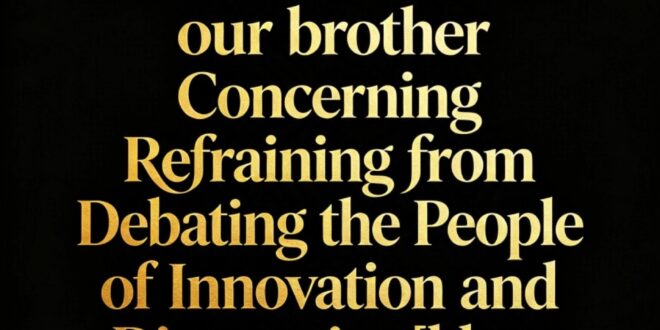
Two days ago, one of our beloved brothers approached me regarding a brother who has been engaging in debates with people of innovation. He asked me to advise the brother concerning this matter. Therefore, I felt the need to write this piece of advice without mentioning his name, so that it may also benefit other Muslims who may face the same issue regarding this topic.
My dear brother — I ask Allah to protect me and you from trials and tribulations, to keep us firm upon the Qur’an and Sunnah, and to grant us the ability to follow the way of the righteous Salaf.
I wanted to offer you a sincere brotherly piece of advice because I have noticed how you enter into public debates and arguments with the people of desires and innovations. I have no doubt that your intention is to support the truth and defend the Sunnah, and this is indeed a noble objective. However, not everyone who wishes to support the truth should take debate and argumentation as the means to do so. Rather, it was from the way of the Salaf to warn against sitting with the people of desires, listening to their doubts, and entering into disputes with them — because of the danger this poses to one’s religion, and because it may result in giving the people of innovation greater status and spreading their doubts among people.
From the Qur’an
Allah the Exalted said:
﴿He is the One Who has sent down to you the Book. In it are verses that are precise — they are the foundation of the Book — and others that are ambiguous. As for those in whose hearts is deviation, they follow that of it which is ambiguous, seeking discord and seeking its interpretation.﴾
— [Āl ʿImrān 3:7]
From the Sunnah
And the Prophet ﷺ said to ʿĀʾishah رضي الله عنها after reciting this verse:
“So when you see those who follow that which is ambiguous thereof, then those are the ones whom Allah has named, so beware of them.”
Statements from the Salaf
Among the strongest statements transmitted from the Salaf concerning this matter are the following:
- Al-Ḥasan al-Baṣrī & Muḥammad ibn Sīrīn رحمه الله
“Do not sit with the people of desires, do not debate with them, and do not listen to them.”
This is among the clearest statements on the subject, for they did not merely prohibit debating them; rather, they prohibited sitting with them and listening to them as well.
- Abū Qilābah رحمه الله
“Do not sit with the people of desires and do not debate with them, for I do not feel safe that they may immerse you in misguidance or confuse you in the religion with some of that which has confused them.”
Consider how Abū Qilābah explained the reason for prohibiting this: fear that a person may become overwhelmed by their doubts, or that the truth may become confused for him because of the doubts they possess.
- Al-Fuḍayl ibn ʿIyāḍ رحمه الله
“Do not debate the people of disputation, for they delve into the verses of Allah.”
This demonstrates that refraining from entering into their disputes is not cowardice before the truth; rather, it is following the way of the people of knowledge and insight.
- Imām Aḥmadرحمه الله
Ḥanbal ibn Isḥāq said: A man wrote to Abū ʿAbd Allāh — meaning Imām Aḥmad — asking his permission to write a book explaining the refutation of the people of innovation, and to attend gatherings with the people of theological rhetoric so that he could debate them and establish arguments against them. Abū ʿAbd Allāh wrote to him:
“In the Name of Allah, the Most Merciful, the Bestower of Mercy. May Allah make your outcome good and protect you from every harm and danger. What we used to hear — and what we found the scholars upon whom we encountered were upon — was that they disliked theological rhetoric and sitting with the people of deviation. Rather, the matter is one of submission and adhering to what is in the Book of Allah and the Sunnah of the Messenger of Allah ﷺ — not sitting with the people of innovation and deviation in order to refute them. For they will confuse you, and they will not turn back. Thus, safety — if Allah wills — lies in abandoning sitting with them and refraining from engaging with them in their innovation and misguidance.”
This is among the strongest texts on the subject, because Imām Aḥmad clarified that the matter is not merely an inability to refute them; rather, safety lies in abandoning sitting with them and engaging with them.
- Imām Mālikرحمه الله
He said:
“Every time a man comes to us who is more skilled in argumentation than another man, are we to abandon what Jibrīl brought down to Muḥammad merely because of his argumentation?”
This is a tremendous statement demonstrating that strength in argument does not make falsehood into truth, and that revelation should not be abandoned merely because an opponent is more argumentative or more skilled in disputation.
He also said:
“Argumentation in the religion generates disputation, removes the light of knowledge from the heart, hardens it, and produces rancour.”
- Imām al-Shāfiʿīرحمه الله
He said:
“Whenever some person from the people of desires came to Mālik, he would say: ‘As for me, I am upon clear evidence concerning my religion. As for you, you are in doubt. Go to someone who is in doubt like yourself and dispute with him.’ Then he recited: ﴿Say, ‘This is my way; I invite to Allah…’﴾.”
- Al-Ḥasan al-Baṣrīرحمه الله
It is narrated that a man said to him, “O Abū Saʿīd, come so that I may argue with you concerning the religion.” Al-Ḥasan replied:
“As for me, I have gained clear insight into my religion. If I have caused you to lose your religion, then seek it.”
This is a tremendous response in cutting the matter short. The servant who has recognised the truth and adhered to the Qur’an and Sunnah is not required to enter into every dispute presented to him by the people of argumentation.
- Abū Qilābah, to Ayyūb al-Sakhtiyānīرحمه الله
He said to him:
“O Ayyūb, preserve four things from me: Do not speak concerning the Qur’an according to your opinion; beware of al-Qadar; when the Companions of Muḥammad ﷺ are mentioned, then refrain; and do not allow the people of desires access to your hearing.”
Consider his statement: “Do not allow the people of desires access to your hearing” — because the heart may be affected by doubts before a person even realises it.
- ʿAwn ibn ʿAbd Allāhرحمه الله
He said:
“Do not sit with the people of Qadar, and do not dispute with them, for they strike parts of the Qur’an against other parts.”
- ʿAbd al-Raḥmān ibn Abī al-Zinādرحمه الله
He said:
“We encountered the people of virtue and jurisprudence — among the best of people — criticizing the people of argumentation and investigation, and considering taking opinions to be among the greatest faults. They would forbid us from meeting them and sitting with them, and they would warn us most emphatically against approaching them.”
- Imām Aḥmad رحمه الله —Concerning the Foundations of the Sunnah
He said:
“The foundations of the Sunnah according to us are: adhering to what the Companions of the Messenger of Allah ﷺ were upon, following their example, abandoning innovations — for every innovation is misguidance — abandoning disputes, sitting with the people of desires, and abandoning disputation, argumentation, and quarrels concerning the religion.”
- Imām al-Baghawīرحمه الله
He said:
“The scholars of the Salaf among the people of the Sunnah agreed upon prohibiting argumentation and disputes concerning the Attributes, and upon censuring delving into theological rhetoric and learning it.”
- Imām al-Lālikāʾīرحمه الله
Among the strongest statements that should be contemplated concerning this matter is the statement of the Ḥāfiẓ Abū al-Qāsim al-Lālikāʾī:
“No harm has been inflicted upon the Muslims greater than the harm of debating the people of innovation. They had no greater defeat or humiliation than what the Salaf left them upon: they would die of anger, grief, and distress, finding no way to make their innovation manifest — until the deluded ones came and opened a path for them to it, thereby becoming a means toward the destruction of Islam. Thus, disputes between them became numerous, and their call became manifest through debate. It reached the ears of those among the elite and the common people who had previously not known of it. Thus, the doubts confronted the proofs, and they reached great depths in argumentation — until they became peers and companions, and through compromise they became friends and brothers, after having been enemies and opponents for the sake of Allah, and allies in abandoning one another for the sake of Allah. They would declare them disbelievers to their faces and curse them openly. How far apart are these two states, and how distant are these two positions!”
This statement should remain present in the mind of everyone who enters into public debates — because one of the consequences of debating can sometimes be that it makes the innovator famous and well-known, and causes his doubt to be heard by people who had not known of it in the first place.
- Al-Ṣābūnīرحمه الله
Imām Abū ʿUthmān al-Ṣābūnī said:
“They hate the people of innovation — that is, the people of ḥadīth hate the people of innovation who introduced into the religion that which is not from it. They do not love them, accompany them, listen to their speech, sit with them, debate them concerning the religion, or engage them in disputation. They consider it necessary to protect their ears from listening to their falsehoods — which, when they pass through the ears and settle in the hearts, cause harm and produce various corrupt whispers and thoughts within them.”
This demonstrates that protecting the ears and heart from the doubts of the people of desires was among the matters to which Ahl al-Sunnah gave great attention.
- The Story of Ṣabīgh ibn ʿAsal رحمه الله
Among the greatest stories cited in this regard is the story of Ṣabīgh ibn ʿAsal, when he began asking about the ambiguous verses of the Qur’an.
Al-Lālikāʾī narrated that when the matter reached ʿUmar رضي الله عنه, he said:
“O Allah, enable me to get hold of him.”
Then, when Ṣabīgh came to him and asked him about the statement of Allah:
﴿By those scattering with a scattering, and those carrying a burden﴾
ʿUmar رضي الله عنه said to him:
“Are you him?”
He then punished him and ordered that he be expelled, saying:
“By the One in Whose Hand is the soul of ʿUmar, had I found you with your head shaved — meaning from the Khawārij, for shaving was one of their distinguishing characteristics — I would have struck your head.”
The purpose of mentioning this story is to demonstrate that the Salaf did not consider sitting with every person possessing a doubt, debating him, and prolonging the dispute to be the treatment in every case. Rather, the treatment may be turning away, reprimanding, warning against, and boycotting him — according to what the Sharīʿah and the circumstances require.
- Al-Lālikāʾī رحمه الله. Summarising the Matter
For this reason, al-Lālikāʾī said:
“No harm has been inflicted upon the Muslims greater than the harm of debating the people of innovation.”
Advice to My Beloved Brother
So, my brother — if you want to support the Sunnah, you are not required to enter into every debate, respond to every doubt, or make the people of innovation permanent opponents of yours in gatherings and public platforms.
Rather, sometimes the strongest way of supporting the Sunnah is not to elevate the status of the innovator in the first place — not to give him the platform he is seeking, and not to make people know him because of the abundance of your responses to him.
My beloved brother — by Allah, I have not written these words to you except out of love for you and concern for you. I do not doubt that the motivation behind many of your responses is your zeal for the Sunnah and your desire to make the truth manifest — and this is something we love and appreciate.
However, I hope that you will reflect upon the way of the Salaf in dealing with the people of desires and innovation. They were extremely concerned with protecting the religion and the heart from entering into disputes and debates. They considered safety to lie in refraining from arguing with the people of desires, and they did not consider a person to be required to respond to everyone who speaks, or to enter into every battle that is opened before him.
I fear for you that responding to the people of innovation may turn from being an occasional means of defending the truth into something that occupies you away from knowledge and worship, consumes your time and heart, and perhaps gives some of these people more publicity and attention than they deserve.
Therefore, my brother, I advise you sincerely for the sake of Allah: leave public debates, and do not make everyone who opposes the Sunnah an adversary with whom you must engage in debate. Hold firmly to the Qur’an and the Sunnah, look at how the Salaf used to deal with such matters, and make your concern to follow the truth — rather than to win an argument.
If an error or innovation becomes apparent and needs to be clarified, then clarify the Sunnah with evidence, knowledge, and wisdom — through video or writing — without making the innovator himself the centre of your call, and without entering into his methods and approaches.
By Allah, I want nothing for you except that you be safer for your religion and your heart, closer to the methodology of the Salaf, and further away from trials, tribulations, and disputes.
I ask Allah to grant you and me success in following the truth, to make us among those who — when they come to know the Sunnah — hold firmly to it, and when they come to know of an error — abandon it. May He grant us submission to Allah and His Messenger ﷺ, sincere adherence to that which the Companions of the Messenger of Allah ﷺ and the righteous Salaf were upon, and may He protect us from trials, both apparent and hidden.
And I remind you of the statement of al-Ḥasan al-Baṣrī رحمه الله:
“As for me, I have gained clear insight into my religion. If I have caused you to lose your religion, then seek it.”
So we ask Allah to grant us clear insight into our religion and to keep us firm upon it until we meet Him.
بارك الله فيك أخي الكريم
أبو إبراهيم الكردي الأثري الحنبلي
الحمد لله رب العالمين